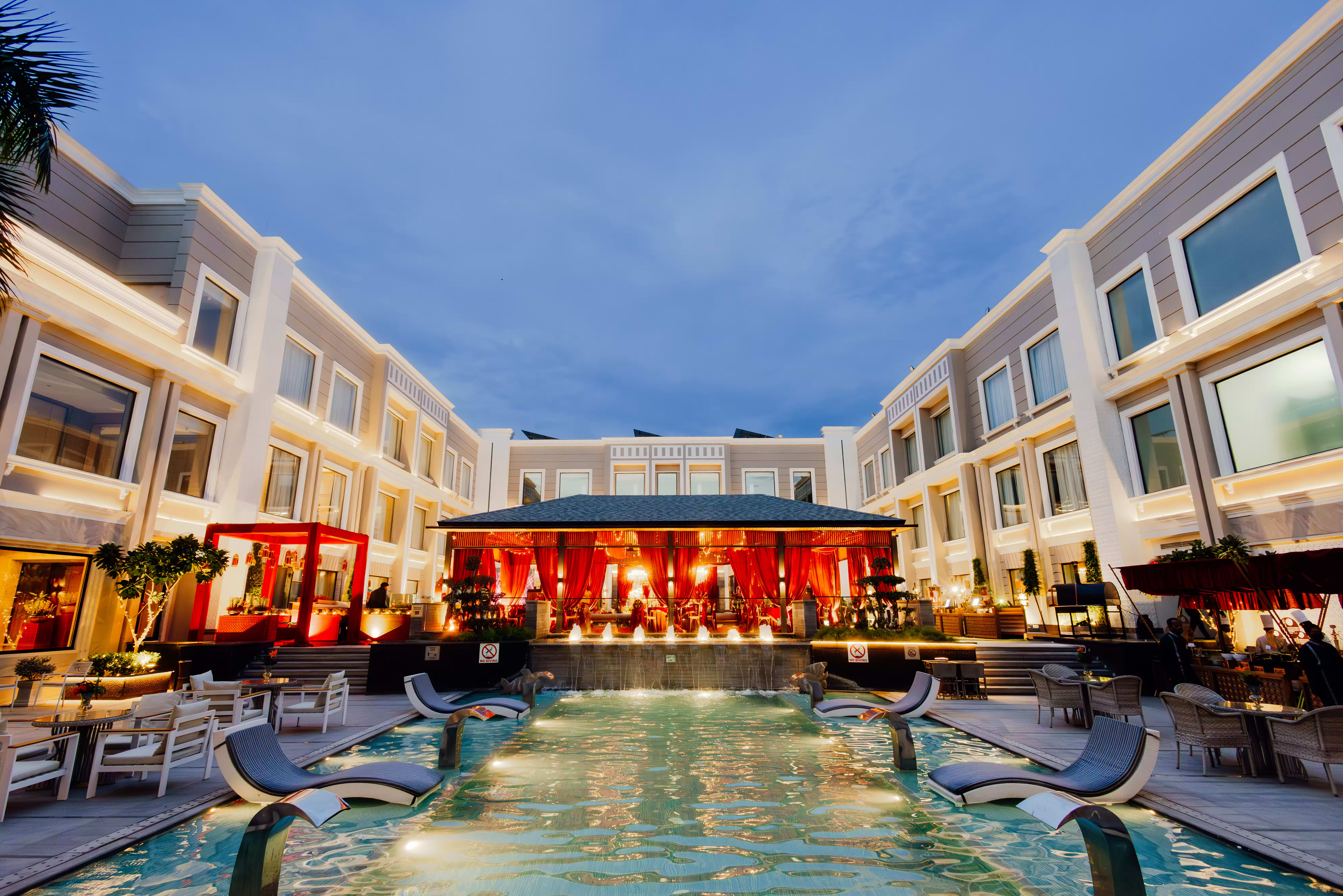
The decision between an outdoor and indoor wedding venue shapes the entire feel of your celebration. An open-air lawn wedding under the stars carries a romantic, expansive quality that is impossible to replicate inside four walls. Conversely, a climate-controlled banquet hall guarantees comfort regardless of the weather, provides superior acoustics for music and speeches, and gives decorators a controlled canvas. In Delhi NCR, where the weather swings from extreme summer heat to dense winter fog and unpredictable monsoons, this choice carries real practical consequences beyond aesthetics.
This guide breaks down every factor you should consider – from weather and capacity to decor flexibility and photography – and maps each to specific Tivoli properties so you can make a decision with confidence.
Weather Considerations in Delhi NCR
Weather is the single biggest factor in the outdoor vs indoor decision for Delhi NCR weddings. The city experiences four distinct seasons, each with different implications for outdoor celebrations.
October – February: Peak Wedding Season
This is the most popular wedding window and the best season for outdoor events. October and November offer pleasant temperatures (18-30°C) with clear skies – ideal for lawn weddings. December and January bring cold evenings (5-12°C) and occasional dense fog that can disrupt outdoor plans. February is transitional with comfortable days but chilly nights. For late-season outdoor weddings, heating arrangements and covered backup areas become essential.
March – May: Summer
Temperatures climb from 30°C in March to 45°C+ in May. Outdoor weddings are possible only in March (evening functions) and become impractical by April-May. Indoor air-conditioned venues are the only comfortable option during peak summer. This is also off-season for weddings, so indoor venue pricing drops significantly.
June – September: Monsoon
Unpredictable heavy rainfall makes outdoor weddings risky. Even when rain does not fall during your event, waterlogged lawns, high humidity, and mosquitoes create challenges. Indoor venues are strongly recommended. Some couples embrace the monsoon aesthetic with covered outdoor setups, but a full indoor backup is non-negotiable.
Outdoor Wedding Venues – Advantages
- Unlimited Capacity Potential: Large lawns accommodate 1,000-5,000+ guests without the structural constraints of walls and pillars
- Decor Flexibility: Open spaces allow towering floral installations, elaborate entrance gates, and 360-degree decor that indoor venues cannot support
- Photography: Natural light, open skies, and expansive backdrops create superior wedding photographs. Golden hour photography on a well-maintained lawn is unmatched
- Atmosphere: The openness creates a celebratory, festive energy that enclosed spaces struggle to replicate. Guests can mingle freely across different zones
- Baraat and Rituals: Traditional baraat processions, fireworks, and outdoor havan ceremonies work naturally in open spaces
Outdoor Wedding Venues – Challenges
- Weather Dependency: Rain, extreme heat, fog, and cold can all disrupt outdoor events. Backup plans add cost and complexity
- Noise Restrictions: Open-air venues face stricter noise regulations than soundproofed indoor halls. Music typically must stop by 10 PM in most Delhi NCR zones
- Insect and Dust Issues: Evening lawn events attract mosquitoes. Windy conditions create dust issues that affect food service and guest comfort
- Infrastructure Requirements: Outdoor venues need portable washrooms, generator backup, temporary lighting, and weather-protection structures, all adding to cost
- Guest Comfort: Elderly guests, children, and guests with mobility issues may find extended outdoor events tiring
Indoor Wedding Venues – Advantages
- Climate Control: Air conditioning in summer, heating in winter. Guaranteed comfort for all guests regardless of weather
- Weather-Proof: Zero risk from rain, fog, dust storms, or temperature extremes. Your event runs as planned, every time
- Extended Music Hours: Soundproofed banquet halls can operate later into the night without violating noise regulations
- Controlled Lighting: Indoor spaces allow precise lighting design – LED walls, programmed spot lighting, and mood lighting that outdoor settings cannot match
- Accessibility: Level floors, accessible restrooms, elevators, and proximity to lobbies make indoor venues friendlier for all guests
Indoor Wedding Venues – Challenges
- Capacity Limitations: Even the largest banquet halls typically cap at 1,000-1,500 guests. Pillar placement can reduce usable space
- Decor Ceiling: Height limitations restrict large installations. Some halls prohibit certain attachment methods that could damage walls or ceilings
- Photography Constraints: Artificial lighting dominates. Natural-light wedding photography requires stepping outside
- Congestion: Large guest counts in enclosed spaces can feel crowded, especially during peak moments like the jaimala or reception line
Outdoor vs indoor vs hybrid wedding venue comparison for Delhi NCR
| Factor | Outdoor Venues | Indoor Venues | Hybrid Spaces |
|---|---|---|---|
| Weather Risk | High – rain, heat, fog, cold | None – fully climate controlled | Low – retractable covers, tenting |
| Capacity Range | 500 – 5,000+ guests | 100 – 1,500 guests | 200 – 2,000 guests |
| Decor Flexibility | Maximum – no height/space limits | Moderate – wall and ceiling limits | High – best of both worlds |
| Photography Quality | Excellent – natural light | Good – relies on artificial light | Excellent – indoor and outdoor options |
| Music/DJ Hours | Limited – 10 PM in most areas | Extended – soundproofed halls | Variable – depends on setup |
| Guest Comfort | Seasonal – weather dependent | Consistent – year-round comfort | Flexible – guests can move between zones |
| Cost Comparison | Lower base + infrastructure add-ons | Higher base – all-inclusive | Mid-range – balanced pricing |
| Best Season | October – February evenings | Year-round | Year-round with outdoor preference Oct-Feb |
| Baraat/Procession | Natural and spacious | Limited or requires outdoor area | Both options available |
Tivoli Properties – Outdoor, Indoor & Hybrid Options
Across the Tivoli portfolio, you will find properties that specialise in outdoor settings, indoor grandeur, and hybrid configurations that give you the best of both worlds.
Best for Outdoor Weddings
- Tivoli Heritage Palace, Rewari – Expansive palace lawns set against royal architecture. Multiple outdoor courts and gardens for different functions. Capacity up to 3,000 guests in open-air settings.
- Omnia Convention, Gurugram – Large outdoor areas with Aravalli hill backdrops. Perfect for grand-scale outdoor receptions with up to 5,000 guests.
- Wedcation Israna – Resort-style lawns and pool-side areas for destination-feel outdoor celebrations.
Best for Indoor Weddings
- The Tivoli, New Delhi – Oakwood Hall (40,000 sqft, 1,000 guests) and Oyster Greens (26,000 sqft, 800 guests) are among Delhi’s largest climate-controlled banquet spaces with premium interiors.
- Tivoli Royal Court, Okhla – Well-appointed AC banquet halls for 100-800 guests in a convenient city location.
- Upper HSE – Boutique indoor spaces with curated interiors for intimate celebrations of 150-1,000 guests.
Best Hybrid Options
- The Tivoli, New Delhi – Emperor’s Court outdoor lawn plus multiple indoor halls. Start the ceremony outdoors and move indoors for dinner and dancing.
- Tivoli Bijwasan – Combination of lawn spaces and indoor banquet halls. Flexible configurations for different weather scenarios.
- Omnia Convention, Gurugram – Multiple indoor halls plus outdoor spaces allow different functions in different settings within the same property.
The Hybrid Approach – Why It Is Gaining Popularity
The hybrid model – combining outdoor and indoor spaces within a single venue – has become the most popular choice among Delhi NCR couples. Here is why:
- Weather Insurance: Start the baraat and pheras outdoors. If weather changes, move dinner and reception indoors seamlessly.
- Variety for Multi-Day Weddings: Host the sangeet on the lawn, the wedding ceremony in the main hall, and the reception in a different indoor space. Each function feels fresh.
- Guest Comfort Zones: Elderly guests can stay indoors while younger guests enjoy the outdoor areas. Everyone is comfortable.
- Photography Flexibility: Outdoor areas for golden-hour portraits, indoor areas for dramatic lit shots. Your photographer gets maximum creative range.
Making Your Final Decision
- Check your wedding month: October-November strongly favours outdoor. April-September strongly favours indoor. December-March depends on your risk tolerance for cold and fog.
- Know your guest profile: A younger, energetic crowd handles outdoor conditions better. If many elderly or very young guests are expected, indoor comfort is worth prioritising.
- Assess your decor vision: If your decorator envisions a towering floral mandap, outdoor space is essential. If LED walls and programmed lighting are the vision, indoor works better.
- Budget honestly: Outdoor venues quote lower base rates but infrastructure add-ons (tenting, lighting, generators, pest control) close the gap. Indoor venues cost more upfront but include most infrastructure.
- Always visit in person: Photos and videos never capture the true feel of a space. Visit outdoor venues in the evening when your event would take place. Visit indoor venues with the lights set to event mode.
Complete guide to the best wedding venues in Delhi NCR
Compare wedding venue regions across Delhi NCR
NRI wedding venue guide for Delhi NCR
Ready to make your celebration unforgettable?
Explore Upper HSE – Boutique Wedding Venue